Thursday, August 2, 2012

Day Three


Day Three


We woke up to the sounds of a gentle surf in the cove.  Matinicus was magical--in part for what it was not.  There were no stores.  There was no movie theater.  There were no restaurants.  There were no pushy social climbers (I suspect social climbing on Matinicus is most often done with fists).  There was no putt-putt golf.  There was nothing to do and nowhere to go.  Just a spectacular, unspoiled Maine island and the Atlantic ocean as far as you could see. 


The joy of getting close to nature may actually be less about nature and more about what is missing from nature.  The absence of roads, shopping malls and cell phones creates a beauty all of itself.  We have an opportunity to breathe, enjoy the people around us and take time for satisfying simple tasks like patching a sail or making a pie.  Anybody who has had the experience of a summer vacation in a cottage on the water knows the feeling.


As an aside, I think we project this feeling when we think about aboriginal peoples who live a natural life close to the land.  On the one hand we want to save them from civilization and all the stress, clutter and environmental degradation that goes with it.  On the other hand, we know they have the right to choose and that they will ultimately not have the strength or perspective to resist the siren call of civilization. 


At some point we too will weaken and leave Matinicus for civilization and, just like corrupted aboriginals that you see in National Geographic with Grateful Dead t-shirts, cans of Red Bull and transistor radios (is that a missionary cooking in the background?), we will return to our iPhones, Outlook calendars and unpaid bills.


That morning Alan made me some good coffee and I rooted around and found some cereal for breakfast.  Today's adventure was going to be a trip on George's boat out to Matinicus Rock, a small island and bird sanctuary several miles away with a famous and still-operational lighthouse.  Our purpose was to see the Puffins' breeding grounds.


These were Atlantic Puffins, small, stocky diving birds--a species of the Auk family.  They nest in small crevices in the rocks where they can find protection from seagulls and other predatory birds.  When the young are old enough to leave, they depart the rocks en masse at midnight--a time when seagulls and other hungry creatures are presumably fast asleep.  The Maine coast is the southern part of their range (which centers on Iceland).  Puffins in this area were all but wiped out by humans who prized their feathers for hats and ate their meat.  They were reintroduced from Icelandic Puffins and have reestablished themselves on Matinicus Rock and elsewhere along the coast. 


The wind was blowing pretty hard but the Robin plowed through the waves and we were rewarded at Matinicus Rock with large flocks of puffins and larger auks.  Ann was a little politically incorrect when, upon hearing of the past practice of hunting puffins for their feathers, asked George if the trip included a complimentary puffin hat and puffin sandwich.


The Matinicus Rock Lighthouse is famous in local lore for the exploits of Abbie Burgess, the young daughter of the lighthouse keeper who, while her father was ashore buying supplies, kept the lighthouse lit through a fierce storm that destroyed most of the buildings on the island, thereby saving countless sailers who otherwise would have been dashed on the rocks.  Locals tell a slightly different story, alleging that the senior Burgess was a drunk who was on a three week bender on the mainland while his family struggled to survive on the rock.  Either way, the stories about Matinicus and its surroundings just kept getting more and more colorful.


Another bit of local lore that we heard on this trip was the story of a fabulous sea rescue of the crew of the Harkness, a 75 foot tug, which became known as the "Miracle on Matinicus."  As the story goes, in January 1993, the Harkness was going down in a fierce gale and sent out an SOS signal that it was taking on water and the crew of two was abandoning ship.  It is hard enough to survive a swim on the beach in Maine in August, much less a sustained immersion in gale-force seas in January.


Two brave men from Matinicus, realizing they were the Harkness's last hope, boarded a lobster boat and headed out into the storm towards the last coordinates the Harkness had broadcast.  Hypothermia was setting in and the two Harkness crew members were having trouble staying together on the ladder they were using for floatation. 


One of the drowning crew members had a flashlight frozen to his glove and, in a miracle, the rescuers from Matinicus caught a brief flash of the light through the gale.  They found the men and managed to get them on board and save their lives in unbelievably difficult conditions.  When looking up the details of this rescue online a few minutes ago, I discovered that one of the rescuers was Alan and Peggy's neighbor Paul Murray (husband of the island's bakery store owner, news reporter, schoolteacher and emergency medical technician Eva Murray).  An unbelievable act of heroism at sea.


When we returned to Matinicus after viewing the puffins, Alan and Peggy took us for a walk around their property.  They are on a 30 or 40 acre undivided property with four owners, each of whom has a separate house.  The property covers two coves, Condon Cove (where Alan and Peggy live) and an adjacent unnamed cove with a beautiful beach.  On the mainland there would be 50 summer houses on this property at a couple of million dollars a copy.  Nice to have it all to ourselves.


That night Alan and Peggy had a party for a bunch of their Matinicus friends which was somewhat in our honor.  After hearing colorful stories about the island residents for years, Ann demanded to meet them in person.  The group included professors, school teachers, artists, lobster fishermen and a venture capitalist.  The group lived up to its colorful billing and everyone had a great time.


One of the attendees was Biscuit Ames, a member of Matinicus's prominent Ames family and a leader of the lobstering community in both Matinicus and Maine as a whole.  The Ames family has been on Matinicus since 1825.  A bunch of them must leave every generation or the place would be overrun by now.


The Ames family has a history that is colorful even by Matinicus standards.  Apparently the islanders are not particularly stuffy about requiring that procreation take place exclusively in the context of marriage.  Biscuit Ames's father was a very successful lobster fisherman and was reportedly the handsomest man on the Maine coast.  Over time, more and more children were born on Matinicus who bore a striking resemblance to Ames senior.  Some of the islanders noticed that every time one of these look-alikes was born the mother received a new washing machine.  Over time people started watching for the washing machines on the ferry and would follow the delivery truck to see whose babies had likely been sired by Mr. Ames.  As I understand it, Ames senior acknowledged many, but not all, of these children as his own.  Surprisingly despite the high number of guns per capita on Matinicus and the high number of washing machine deliveries, nobody ever got shot.  These guys save their bullets for the important stuff--lobsters.


Alan's daughter Grace fishes as a stern man (woman?) with Biscuit from time to time as one of her summer jobs.  At my urging, she asked Biscuit during the party if I could go lobstering with them the following day.  He sized me up and decided either that (a) I would make good lobster bait or (b) this would be the best entertainment he'd had all summer, or (c) both, then agreed. 


If you have ever seen the cable TV show about the Deadliest Catch (fishing somewhere in the Bering Sea for king crabs or god-knows-what) you will have a good sense of my expectations for the experience.  Hypothermia, concussion, loss of minor extremities--all were good possibilities.  Oddly, everyone at the party who found out I was going to go fishing with Biscuit looked at me wide-eyed and then would laugh.  When I asked them what they were laughing about, they would just act as though they hadn't heard me and and wander off chuckling.


We met a number of other interesting people at the party, including Paul and Eva Murray who together do just about everything that needs doing on Matinicus other than catching lobsters.  Paul is in charge of the electric utility, the phone system, the microwave communications link to the mainland, the recycling center and probably several other things I've missed.  Eva has the only commercial enterprise on the island, a bakery, and in her spare time is the schoolteacher, the emergency medical technician (there is no doctor) and news reporter.  As I mentioned earlier, Paul was one of the heroes of the Harkness rescue.  As if that were not enough, Eva had recently done a heroic job of rescuing herself from a harrowing airplane crash of the single engine plane that services the island's grass landing strip.  Paul and Eva were an extremely impressive couple.

Eva and Paul Murray after Eva's Plane Crash


After the party I went to bed as soon as possible and steeled myself for the early morning wakeup call.  We were scheduled to be on the water at 4:00 am. 

Introduction to Matinicus Island


Matinicus Island

Matinicus Island, Maine


Matinicus is a remote island approximately 30 miles off the coast of Maine, due east of Boothbay Harbor.  It has a year-round population of about 50 and a summer population of about double that.  Unlike many of the closer-in islands, Matinicus is populated principally by lobster fishermen and has remained unspoiled and relatively undiscovered by the tourism that has taken over the rest of the Maine coast.  Matinicus has no restaurants, no tennis courts, no golf courses and no New Yorkers. 


Matinicus thinks of itself as a pirate island.  Yes, I said pirate.  The islands remote location made it an ideal refuge and staging area for pirate raids along the Maine coast from the beginning of our nation's history.  Among the various pirates who harbored at Matinicus was Edward Teach, better known as Blackbeard the Pirate, who spent his last summer on the island in 1718 before being killed in a ferocious battle off the outer banks of North Carolina in November of that year (where he had presumably gone to get warm).  In more recent eras, Matinicus has been a haven for rumrunners during prohibition and is rumored to harbor drug runners from time to time to this day.

Blackbeard


The first true white settler of Matinicus, Ebenezer Hall, was a missionary and squatter who moved to the island in 1750 and proceeded to burn the island to make it better grazing land for his livestock.  His burning and proselytizing drove the local Indians to write to the governor demanding his removal.  When no action was taken they took matters into their own hands and burned his house, shot him through with arrows and scalped him (always a good solution for obnoxious missionaries).


As Wikipedia says, So began the island's 250-year era of insularity and frontier violence. Residents developed a reputation for wanting to be left alone; outsiders and tourists were not welcome. It was not infrequent for visiting sailboats to be shot at, and the Maine State Police were under orders not to be on the island after dark. Several boating magazines listed Matinicus as a "hostile harbor," and locals openly referred to it as a "pirate island." The state gave up enforcing vehicle laws on Matinicus in the 1950s, so license plates (and brakes) are optional on the rusted vehicles that ply its unpaved roads. More recently, however, outsiders have purchased property and built summer cottages on the island, whose economy is now comfortable with the seasonal influx of tourist dollars. Only interference in local lobster fishing invites trouble.


Which brings us to recent lobster wars.  Matinicus and neighboring island Vinalhaven share the richest lobstering area in the world.  There are no legal restrictions against lobstering anywhere on the Maine coast, but Matinicus fishermen enforce a three mile limit where only fishermen with a hereditary claim can fish.  Several years ago during a slump in the lobster industry, an outsider with no meaningful ties to Matinicus began fishing in these waters.  He was shot (and almost killed) in Matinicus harbor.  A jury of the shooters peers did not convict him, notwithstanding the fact that the shooting took place among a crowd of witnesses.  Mission accomplished--the offending fisherman now respects the three mile limit. 


There is no law enforcement on the island.  Its governmental form is an arcane structure known as a Plantation, which basically means there is no government.  When the Rockland sheriff appointed a deputy on Matinicus several years ago, the appointee took his job a little too seriously and tried to bring order to the island by, among other things, reporting that the local postmaster was closing the post office a half hour early.  His boat was burnt to the waterline and shortly thereafter he left the island never to return.


Groceries, furniture, building materials and appliances all have to be purchased on the mainland and brought over by the ferry (service is twice a month) or by George (on demand).  The island has a limited number of cars and trucks, but since the total land mass of Matinicus is two square miles, these vehicles do not put a lot of miles on the odometer.  They also, due to the aforementioned lack of government or law enforcement, do not need license plates.  Conveniently, the lack of law enforcement also means that drivers need not be sober nor need they possess a drivers license.

North Haven Ferry in Matinicus Harbor


Had I known any of this I probably would have thought twice about accepting Alan and Peggy's invitation.  However, notwithstanding the colorful reputation of the island and its people, we found it to be a spectacularly beautiful spot with wonderful, down-to-earth people.  Parrots on the shoulder and peg legs had apparently gone out of fashion and hardly an "Aaaarrrrggghh!" was heard.

Day Two


Day Two


The next morning we got up, had a breakfast of Merry's delicious home-made granola and then imposed on Rob to take us on his boat around Booth Bay Harbor.  Rob had a very seaworthy 25 foot-or-so outboard.  We paddled the dinghy out to the mooring, cast off and then motored into Booth Bay.  We saw porpoises breaching the surface and a large boat reminiscent of Rodney Dangerfields yacht in Caddyshack leaving the harbor completely ignoring the "no wake" regulations in the harbor.  Booth Bay looked exactly as it had 45 years ago but I imagine the stores were a little fancier and the food a little more upscale.  Rob pointed out some houses owned by fellow Clevelanders, including the Norwebs, Marshalls and Newells.


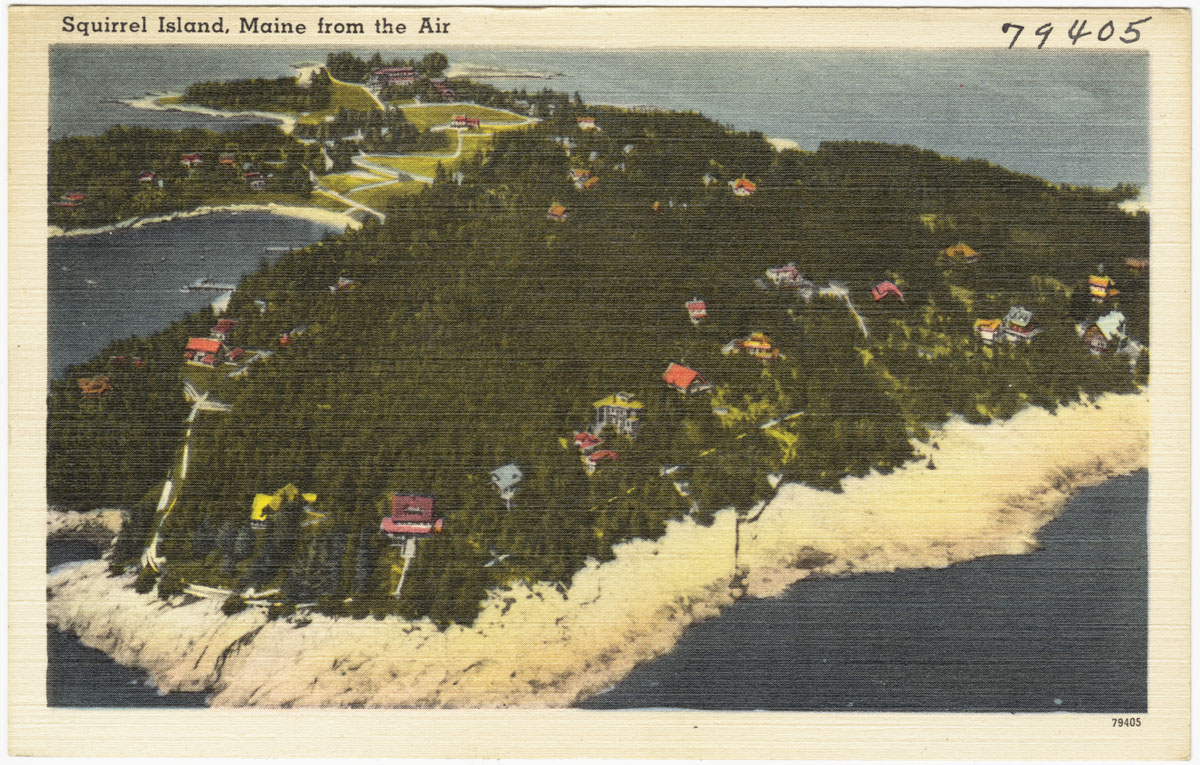
Rob offered to dock for a few minutes at Squirrel Island for a walk down memory lane.  He dropped us off at the dock and Ann and I spent a quick half hour walking around the island, which eventually I was able to put into the perspective of my 12 year old brain (the last time I had set foot there).  We saw lots of islanders walking past us staring vacantly ahead and were reminded of Children of the Corn, a movie neither of us had seen that we believed involved some sort of mass mind control.  We discovered later that they were going to the dock to meet the ferry.

Squirrel Island, Maine


Rob then cruised through South Bristol and then back to Christmas Cove where we packed up and skedaddled--we had a 2pm boat out of Rockland that we could not miss.  We had a leisurely drive up the coast to Rockland and had time for lunch so we went to the old school Rockland Cafe where they served us seafood chowder, fried clams and shrimp salad.  Totally legit, as my kids would say. 


We then went to the grocery store to get provisions for Matinicus (there is no store on the island).  Our shopping list was wine, beer, ice, a cooler, and a bunch of produce.  I made the mistake of challenging Ann to a shopping smackdown--the produce included a lot of items and sounded very complicated and my stuff seemed easy--wine, beer, ice.  Seemed like a guaranteed win.  Sadly, Ann crushed me by showing up at the register while I was still wandering the aisles in a confused state looking for beer.  Apparently all the produce is in the same place.  Who knew?  Never challenge a woman at grocery shopping.  No upside.


We got to the marina with our luggage and groceries in plenty of time and met our captain, George, who welcomed us aboard the Robin, a 40 foot steel and fiberglass diesel power boat that seemed like it could handle anything mother nature threw at it.  We powered out of Rockland and got to Matinicus in about an hour and a half. George led Ann to believe we would likely see whales on the way out.  On the cruise, I told Ann we were doing the punching game (as in your kids see a Volkswagen on the highway and punch one another) but with whales.  Unfortunately, no whales.


As we approached Matinicus we saw a big party underway on the beach.  There was a good sized tent, music, beer and a couple of grills.  We got to Matinicus harbor a few minutes later and saw Peggy (Ann's sister) and Peggy's husband Alan on the dock waiting for us.  We said goodbye to Captain George, threw our luggage and some blueberry bushes that Peggy had ordered in the back of Alan's Ford pickup and headed off down a dirt road, the girls bouncing in the back of the pickup with the luggage and the blueberry bushes.  A mile or so later we pulled up to their beautiful little cottage on Condon Cove.

Alan's Pickup


Peggy and Alan's daughter Grace rode in on her bike a few minutes later.  She had been at the beach party and saw our boat come in.  Apparently, the party on the beach was a wedding.  When Grace left the beach the wedding had not yet begun (two hours after its scheduled start), the guests had already drunk two kegs of beer and the groom had not yet shown up.  The groom may have still been recovering from a bachelor party that was the talk of the island involving several strippers flown in from the mainland.  All of this will make more sense to the reader after tomorrow's installment which will be a short primer on Matinicus Island, its people and its culture.

Alan and Peggy's House


We got settled, took a walk around the property and met a couple of neighbors.  The setting was spectacular--they had a commanding view of Condon Cove and looked East over the Atlantic--next stop Portugal.  We had a glass of wine on the deck and were treated to a delicious lobster dinner.  We stayed in a guest bedroom above the kitchen that was accessed by steep stairs.  Ann looked at the stairs and concluded that death or severe injury was imminent.  She spent the night with one eye cocked on me in case I should get up to go to the bathroom and fall to my death, while I kept one eye cocked on her to make sure she didnt get up and sleepwalk and tumble down the stairs (I am not making up the sleepwalking).  Nobody got hurt but nobody got much sleep either.

Day One


Day One


Things were busy in the office so I worked in the morning and we took an afternoon flight out of Akron to Boston.  When I made the reservations I thought we would stay with my brother Fred in Boston for the night but he and Cindy were out of town.  With no good reason to stay in Boston for the night, I arranged to drive up to Christmas Cove, Maine and spend the night at the McCreary compound, summer home of my business partner Rob and his wife Merry. 


Christmas Cove is on Rutherford Island, just past South Bristol and adjacent to Booth Bay Harbor.  It is a charming old summer community filled mostly with hard-bitten New Englanders but also containing some nice, friendly Midwesterners like the McCrearys.  Christmas Cove was where the McDaniel family long had summered and, since Merry's dad Gus McDaniel died a few years back, Rob and Merry not only have their house but Gus's house as well.  This gives them an opportunity to put a little distance between themselves and their grandchildren but also presents them with the usual maintenance headaches that come with an 80 year old summer cottage.

Christmas Cove


Speaking of hard-bitten New Englanders, I have a theory about why they are so reticent and reserved (and generally look as though they just sucked on sour grapes).  You will recall from your visits to New England that there are stone walls everywhere.  The ancestors of modern New Englanders dug these stones out of their fields by hand, thereby demonstrating their determination, work ethic and limited intellectual capacity.  This hard life made them surly and depressed.  The walls made it difficult to maintain relationships with their neighbors (recall Robert Frosts poem Mending Wall).  Accordingly they developed a culture of insularity, negativism, and (as demonstrated daily by the "Red Sox Nation") stupidity.

Typical New Englander


At the same time, Midwestern pioneers had plenty of rich, fertile land with few stones.  Since leaving the hard life in New England was the equivalent of winning your town's intelligence test, a Darwinian process brought the best and brightest from New England westward.  There was no stone digging, wall building, surliness or insularity.  As a result, we in the Midwest are blessed with happy, outgoing, smart peoplea stark contrast to our eastern brethren. 


But back to Maine and the story at hand.  My dad and his family spent summers across the bay from Christmas Cove at Squirrel Island, a nice summer community filled with the same hard-bitten New Englanders and the same sprinkling of nice Midwesterners.  I spent a summer there as a young kid.  My grandfather, whom I never knew, was reportedly a difficult SOB with a somewhat sadistic, dry sense of humor.  He probably fit in with the New Englanders just fine.


We drove up Route 1 along the coast and arrived at Christmas Cove fairly late--around 9:30.  Rob acted as ground control on the cell phone and brought us in for a perfect landing at Gus's house where we would spend the night.  His son in law Rob Hartford and daughter Jennifer were there and welcomed us with a beer and some peanuts.  Merry unfortunately had left that day for Cleveland to tend to her ailing mother.  We were introduced to the Hartford's King Charles Spaniel, Gilbert (a tennis ball junkie) and my old hunting pal, Rob's chocolate Labrador, Buoy.  We were honored with the master bedroom and sacked out early in Christmas Cove comfort.

Summer Vacation 2012--Introduction


Summer Vacation 2012

Gorman Chairback AMC Lodge


Sometime last winter I got an email from my brother Fred asking if Ann and I would like to spend a week with him and his wife Cindy in the Maine woods.  We would be staying at an Appalachian Mountain Club lodge in northern Maine.  AMC operates lodges for hikers throughout New England, notably in the White Mountains of New Hampshire and, as I discovered from Fred's email, in the north woods of Maine.  It would be rustic, but we would have beds, other people would do the cooking and we could spend our days hiking, fishing, reading books and napping. 

To me this sounded great.  When Fred and I have gotten together in past summers we have gone backpacking and fly fishing in the Rockies (something we had been doing on and off since we were 8 years old on trips with our father).  However, at age 58 and 57, respectively, the prospect of riding a horse 25 miles into the wilderness then putting a 50 pound pack on our backs and climbing up and down mountains for a week had become more daunting.  To me, the week in the Maine woods at AMC sounded luxurious and decadent. 

However, in a lesson that perceptions are relative to one's experience, I discovered that Ann did not share my view that AMC would be the lap of luxury.  It seems she has an aversion to the words "rustic" and "vacation" in the same sentence.  This unfortunate conjugation in Fred's initial email had put her on high alert.  I had described our destination to her as a "nice lodge in Maine" and in her mind, this implied flowers, terrycloth monogrammed bathrobes and a large staff.   She became suspicious when she saw Fred's email and began to research AMC on the internet.  There she found "helpful tips" (as the AMC website called them) about bringing one's own sheets and towels, preparing for foul weather, warding off insects, hiking treacherous trails and participating in "family dining".  This helpful information set off more alarm bells and I began to sense some resistance from my spouse, a self-described "delicate flower" and "urbanite".  As in (and I quote) "You bet your ass I'm a delicate flower!!"

To make matters worse, Fred sent a follow up email titled "Bugs in Maine" which discussed black flies in detail, including the need to wear a headnet, long sleeved shirts tucked into gloves and long sleeved pants tucked into socks.  Words like "swarms", "bites" and "relentless" appeared frequently.  This did not go over well.

For fun and relaxation I tend to gravitate towards hiking and fishing, while Ann tends to gravitate towards yoga studios and spas.  The way she thinks of it, I like bugs and sleeping on the ground while she likes to act like a normal human being.  She has a paranoid fantasy that my goal on vacation is to kill her, which is not true.  That would be no fun. 

During our courtship,  Ann was a remarkably good sport and would cheerfully go on ski trips, mountain bike rides and once even a fly fishing trip (in this latter case the cheerfulness was short lived).  Interestingly, since we were married two years ago she seems less open to such activities.  Bait and switch?

Ultimately we decided that four days at the AMC lodge would be perfect--enough time for me to get the hiking, fishing and "family dining" out of my system but not long enough for her to have lost the will to live.  We then realized that we could use the rest of the week to visit her sister and brother in law, who have a cottage on Matinicus Island off the coast of Maine.  We had been wanting to visit Peggy and Alan at their summer place for years but had never been able to make it work.  This seemed like the perfect opportunity.

Matinicus Island, Maine


Sadly, Ann's dog Daisy was not invited on this trip.  The AMC lodge was not pet-friendly and we would be flying (Daisy is also a delicate flower--she does not do luggage compartment).  Ann arranged for two of her colleagues from her office at LAND-Studio to stay at our house for the week and take Daisy to work (yes, Daisy works). 

Daisy


We made our reservations.  The die was cast.  Summer vacation in Maine, 2012.